↗
Ownership continuity
Is the transferor connected to the preceding ownership history?
AI-powered property legal intelligence
TitleDiligence helps lawyers bring fragmented property documents, records and evidence into a connected view. It reconstructs ownership histories, identifies inconsistencies and surfaces material findings with supporting evidence for lawyer review.
Multiple document types
Connected intelligence
Built for legal review
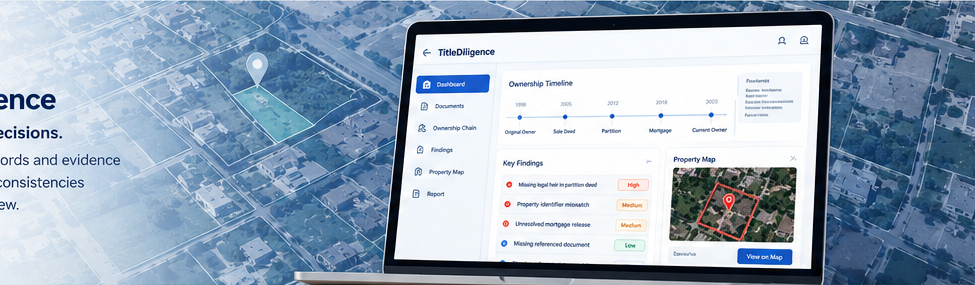
Connected property intelligence
Ownership journey · Findings · Property context

The challenge
A property's legal story is spread across sale deeds, partition deeds, family trees, encumbrance certificates, survey maps and revenue or municipal records. Each document describes part of the story—and they may not all agree.
Our solution
TitleDiligence uses AI and legal-domain validation to understand documents, connect people and properties, reconstruct ownership histories and identify inconsistencies with supporting evidence.

How it works
Each step helps transform individual records into a structured view that a lawyer can investigate.
Classify and structure information from deeds and supporting records.
Link people, properties, ownership interests and transactions.
Build a chronological view of ownership and transactions.
Compare documents to identify conflicts, missing links and gaps.
Surface material questions using legal-domain validation checks.
Trace findings to evidence and decide what needs investigation.
Illustrative case
A Sale Deed records a transfer. A Family Tree identifies three legal heirs. A subsequent Partition Deed includes only two of them. TitleDiligence connects the supplied documents to surface the missing ownership question for legal investigation.
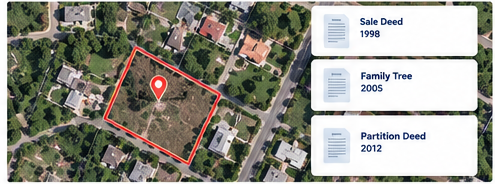
Sale Deed
Ownership transfer
Family Tree
Three heirs identified
Partition Deed
Two parties shown
Illustrative scenario and map artwork only. The legal effect depends on the full facts and applicable law.
Validation checks
TitleDiligence can help surface potential inconsistencies and missing links for lawyer review.
Is the transferor connected to the preceding ownership history?
Is a legal heir absent from a partition or subsequent conveyance?
Do survey, Hissa, site and other identifiers agree across records?
Does the stated property extent differ across documents?
Does the release clearly correspond to the earlier mortgage?
Is a cited instrument missing from the review set?
A flagged discrepancy is not automatically proof of defective title or wrongdoing. It may require additional evidence and professional assessment.
Who it is for
Reconstruct ownership histories and investigate material issues.
Support complex title-diligence workflows.
Organise and reconcile property information.
Support property-related legal and collateral review.
Our technology
TitleDiligence combines document processing, LLM-based understanding, entity and property resolution, timeline reconstruction, rule-based validation and evidence traceability.
Structure information from supplied documents.
Understand unstructured document content.
Connect references across records.
Check defined conditions and discrepancies.
Designed for lawyer review
The lawyer remains responsible for verifying evidence, interpreting applicable law and making the final legal assessment.
Get in touch
Request a demo or discuss a pilot to explore how TitleDiligence can support your legal workflow.